The term historic, or listed, building refers to a building that is not necessarily just old, but one that defines or marks our history. There are many reasons why a building maybe marked as historic or listed, it may be because it was designed by a well-known architect, because it was the place where a significant event occurred, because it was typical of a certain era or because it has certain aesthetic merits.
Larger historic buildings such as museums, art galleries and houses containing collections are open to the public and, therefore, are required by law to have a suitable fire detection system in place.
What are the Risks?
There are a number of fire risks that are commonly associated with historic buildings:
Building or Maintenance Work
This has been the cause of several major fires due to:
- Careless application of heat, including paint stripping, leadwork to roofs and plumbing;
- loss of fire separation, caused by the removal of doors;
- temporary isolation of fire detectors, and;
- potential ignition sources such as temporary lighting and sparks from cutting apparatus.
Electrical Faults
In older buildings, the wiring may be old and may have deteriorated over time. Alterations, overloaded circuits and faulty or ill-maintained appliances also pose an increased risk of fire.
Open Flames
Open fires, stoves grates and hearths are also a significant risk. As well as this, defective flues, ducts and shafts can also cause a fire to spread more rapidly.
What are the Challenges?
A listed building may not be demolished, extended, or altered without special permission from the local planning authority. Therefore, fire alarm engineers can face a number of challenges when designing a suitable fire alarm system to protect a historic building from fire.
There is often a conflict between ensuring the safety of a building’s occupants while meeting the requirements of the property’s protection. In order to strike this balance, Fire Risk Assessments need to be carried out to ensure that the character of the protected building is retained and suitable detection solutions are in place. Any significant change to the building needs to be justified and within the fire risk assessment to ensure it is possible to achieve safely.
Fire alarm systems for historic or listed buildings must be sensitively integrated, should have minimum impact on the structure and should be reversible – if it is removed then the listed aspect of the building must remain intact as it was before.
What is the Solution?
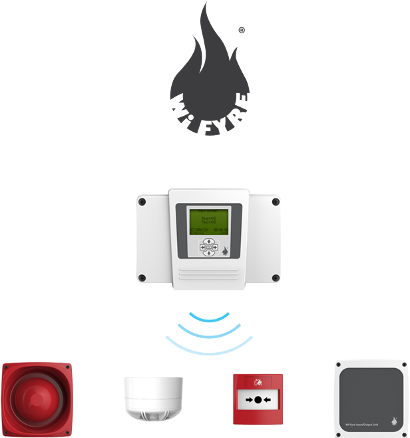
Integrating wireless and hardwired fire detection technology can help to provide a complete fire detection solution that protects not only life but property and business continuity.
Wi-Fyre allows wireless fire detection devices to integrate seamlessly with a hardwired fire detection system. This means that a number of different detection types can be used to ensure that suitable protection is provided, with minimal impact on the property.
With a hybrid fire alarm system, wireless devices can be installed in areas where cables would cause disruption to the integrity or aesthetics of the building, while hardwired traditional type detectors can be used where necessary. As well as this, other detection types such as aspirating smoke detection can be used where traditional type detection may be ineffective – i.e. areas with high ceilings or particularly voluminous areas.
How Does Wi-Fyre Work?
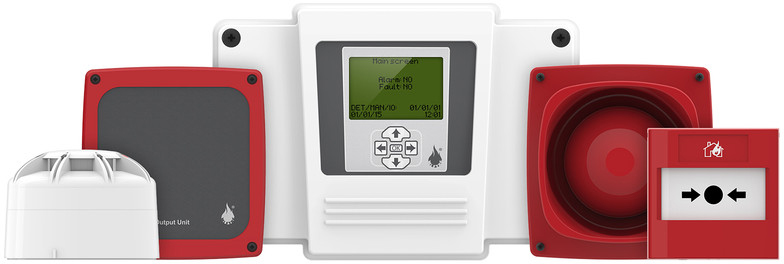
Wi-Fyre wireless field devices connect to the fire alarm control panel via a Wi-Fyre Transponder. The transponder is connected via a compatible interface module which is installed into the fire alarm wiring. Each transponder is able to communicate with up to 30 mixed field devices, including smoke and heat detectors; manual call points; sounders and interfaces.
A wireless survey must be conducted using the Wi-Fyre survey head to ensure that the signal between the transponder and connected device is strong enough to provide reliable and efficient detection.
If you would like to discuss how you can use Wi-Fyre to benefit your fire alarm system, please feel free to give us a call on +44 (0)1329 835024 or email info@eurofyre.co.uk where we would be happy to answer any questions.
Don’t forget you can follow us on LinkedIn, Twitter, Facebook and Google+ or sign up to our newsletter (in the footer below) to receive all the latest information from Eurofyre.